Join our community of practice
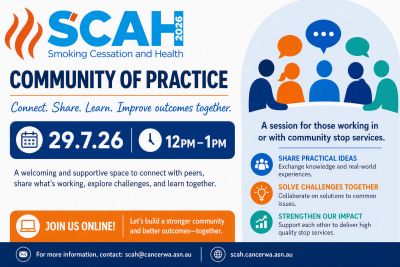
Join our Community Smoking Cessation Community of Practice – 29th July 2026 (12:00–1:00pm)
We’re pleased to invite you to the second meeting of our Community Smoking Cessation Community of Practice on 29th July 2026, 12:00–1:00pm.
This session is designed for those working directly in community settings to support people to quit smoking, including stop smoking advisors, outreach workers, community practitioners, and local partners.
This is an opportunity to come together with others delivering smoking cessation support in community settings, share what works, and build a national network focused on reducing inequalities and improving outcomes at a local level.
We look forward to welcoming you.
Registration closes at 11:50am on 27.726.
View the SCaH NCSCT Webinar recording
SCaH/NCSCT Webinar on 13th may 2026
On 13th May 2026 SCaH partnered with the National Centre for Smoking Cessation Training (NCSCT) to present a webinar on: Cut Down to Stop (CDTS) Interventions.
Webinar aim
This webinar provided an overview of the evidence base for Cut Down to Stop (CDTS), explored implementation of CDTS within service delivery models and introduced a suite of new NCSCT resources:
- the CDTS briefing for stop smoking services
- the CDTS Treatment Programme, and
- planning resource for clients.
Webinar Objectives
This webinar covered the following:
- Gave an overview of the evidence base underpinning CDTS.
- Considered the implementation of CDTS within service delivery models, including key challenges, enablers.
- Highlighted the new CDTS delivery resources—including the new NCSCT CDTS treatment programme and client planning resource—and showed how they support effective practice and help to address common challenges.
- Covered monitoring and recording to demonstrate CDTS progress, engagement and outcomes.
- Reflected upon key considerations for implementing CDTS across a range of settings.
Agenda and Speaker Plan
- Heidi Croucher, Founder and Joint Lead Convenor, SCaH. Welcome & housekeeping.
- Dr Sophia Papadakis, PhD, MHA, Academic and Health Systems Consultant, NCSCT and Susan Montgomery, Training Lead, NCSCT. CDTS in Service delivery models, key challenges and enablers. Evidence and best practice principles for CDTS; implementation; challenges and enablers for services and monitoring.
- Mary Yates, Expert consultant, NCSCT. Introducing the NEW CDTS treatment programme and planning resource for clients. Walk through of the new plan and how it supports good practice and highlighting some common challenges.
- Martin Lever, Joint Lead Convenor, SCaH. Adapting CDTS to different client needs. Considerations for using CDTS in different settings.
Smoking Cessation Webinar: Partial Agonists in Secondary Care
Webinar: Accelerating Local Progress Towards a Smokefree Future
Wednesday 22nd April 2026 (12 - 1:30pm) on Microsoft Teams
SCAH hosted a webinar series for Local Authorities & Community Stop Smoking Services designed specifically for community practitioners, service managers, commissioners, and public health leaders. The session spotlighted innovation, shared best practices, with the intention of supporting efforts to accelerate local progress toward a smokefree future, with a focus on effective smoking cessation strategies.
Agenda
Welcome by Heidi Croucher, Founder and Joint Lead Convenor, SCaH.
Russ Moody, Health & Wellbeing Programme Lead, OHID Russ provided updates on the current national picture, including the LA Community Grant (2026-2029) and the Tobacco and Vapes Bill.
Hilary Wareing, Managing Director, Improving Performance in Practice (iPiP) Hilary provided expert insight on the CLeaR Self‑Assessment and Peer Assessment tools, and maximising use of available tools and frameworks, including partial agonists, to end smoking.
Smokefree Generation Funding in Action: Successful strategies for reducing health inequalities and practical pathways to achieving a 5% smoking prevalence rate. We heard from local areas, highlighting real‑world examples of areas that have rolled out innovative service models achieving exceptional reach among groups traditionally hardest to engage:
Kirklees Community Mental Health Orla Madden, Smoking Cessation Pathway Development Lead, Kirklees Wellbeing Service.
Birmingham Rough Sleepers Keiran Mckenzie, Adults Team Service Lead, Public Health Division, Birmingham City Council (with Dr Mary Ilesanmi and Rachel Emmerich).
Dorset's targeted approach to engage a wider range of communities Sam Harvey, Behaviour Change Team Manager, LiveWell Dorset, and Sarah Arnold, Training and Engagement Manager, LiveWell Dorset.
Martin Lever, Joint Lead Convenor, SCaH Martin shared details about the ScaH Hub that will feature guest speakers, opportunities to share and learn, and provide peer support.
Q&A
PARTIAL AGONISTS IN SECONDARY CARE WEBINAR
24.3.26
Essential updates for the smoking cessation community: Partial Agonists in Secondary Care, and Community Hubs.
Tuesday 24th March 2026.
A Partial Agonist (Cystisinicline and Varenicline) Recap
Heidi Croucher, Founder and Joint Lead Convenor, SCaH.
As partial agonists return to the forefront of treatment options in our smoking cessation efforts, we’ll provide an accessible overview including:
How partial agonists work and why they’re effective
Safety and suitability considerations
Evidence supporting their use in routine cessation care
A great refresher for all frontline professionals.
Smoking Cessation Service (Advanced Pharmacy) – Key Changes
Rob Hebdon, Senior Policy Lead – Pharmacy Clinical Strategy, Primary Care & Community Services, NHS England.
Pharmacy teams play a crucial role in the next phase of our Smokefree strategy. This segment outlined:
Updates to the Advanced Pharmacy Smoking Cessation Service
Referral pathways and best-practice approaches
Support tools being rolled out to enhance quit success rates.
PGD Support for Partial Agonists & the New Smoke Free Offer
Louise Ross, Clinical Consultant (NCSCT) and Stop Smoking Lead, Smoke Free Digital.
Louise gave an update on the new Patient Group Direction (PGD) support, making partial agonists more accessible across clinical settings.
Topics include:
PGD framework and training requirements
How the new Smoke Free offer integrates medication support
Practical tips for implementation across services.
Embedding Partial Agonists into Outpatient, Peri‑Operative & ED Pathways
Martin Lever, SCaH Joint Lead Convenor.
As part of the NHS 10-Year Plan, a key focus in 2026 will be to expand support beyond primary care. Martin outlined:
How hospitals can initiate partial agonists during outpatient visits
Peri‑operative benefits, including improved surgical outcomes
Opportunities for brief interventions and prescribing in Emergency Departments.
This session aims to support consistent adoption of partial agonists across secondary care.
Community Hubs: A 10‑Year Vision for Smoking Cessation
Darush Attar-Zadeh Clinical Fellow Respiratory Lead pharmacist in NW London. Primary Care Respiratory Society (PCRS) Executive Chair. Co-Chair Task Force Medicines Optimisation Committee and part of the IPCRG teaching faculty for treating Tobacco Dependence and Asthma Right Care.
Darush explored the role of Community Hubs within the long-term Smokefree strategy. Topics include:
How hubs can serve as accessible, non‑clinical touchpoints
Integration with wider wellbeing and prevention programmes
Opportunities for local organisations to participate in future development.
Interactive Q&A
Join our webinar series for further insights and updates on smoking cessation strategies.
SCaH/Intermedical webinar
Carbon Monoxide Breath Testing Beyond Cigarettes: Emerging Evidence and Best Practice in Community and Secondary Care
Tuesday, 3rd February 2026
Speakers
Louise Ross – Clinical Consultant (NCSCT) and Stop Smoking Lead, Smoke Free Digital
Heidi Croucher – Lead Convenor, Smoking Cessation and Harm Reduction (SCaH) and Lead Treating Tobacco Dependency Midwife, NHS England Prevention
Kevin Smith – Harm Reduction Practitioner, Dorset HealthCare
Session Overview
Carbon monoxide (CO) breath testing is widely recognised as a key tool in smoking cessation, but its role is expanding across community, maternity, mental health, and secondary care settings. This webinar series will explore emerging evidence, practical applications, and real-world examples demonstrating how CO breath testing can support wider tobacco dependency treatment and harm reduction pathways, including the use of partial agonists in therapy.
Topics
Carbon monoxide breath testing in the community | Shisha use and carbon monoxide exposure | Cannabis use and carbon monoxide | Embedding CO breath testing within secondary care as best practice | Case study from a Dorset mental health inpatient hospital | Live Q&A session
BRACE webinar
Smoking Cessation Services for People with Serious Mental Illness: A Rapid Evaluation
Tuesday 9th December 2025
Speaker: Dr. Jennifer Newbould, Senior Research Leader at RAND Europe and member of the Executive and Co-PPIE Lead for BRACE (The Birmingham, RAND and Cambridge Evaluation Centre, funded by the National Institute for Health and Care Research).
In this webinar series, Jennifer presented the BRACE study, a rapid evaluation of NHS England’s stop smoking services for people with severe mental illness (SMI).
Drawing on a mixed-methods approach, Jennifer discussed findings on service delivery, measures of success, and referral pathways, including the role of partial agonists in smoking cessation. She also shared insights from individuals with lived experience of both smoking and SMI. Jennifer concluded by offering recommendations for service development, policymakers, and future evaluation initiatives.
Dr. Jennifer Newbould has over twenty-five years’ experience in health services research, focusing on rapid evaluation, primary care, and patient experience. Currently, she co-leads the Drug Strategy Investment in Treatment And Recovery (D-SITAR) Evaluation (with Ms. Lucy Strang, RAND Europe) and the CONCORD: Coordinated Care of Rare Diseases study (with Prof. Stephen Morris, University of Cambridge). She is the Principal Investigator on the smoking cessation project for people with serious mental illness.